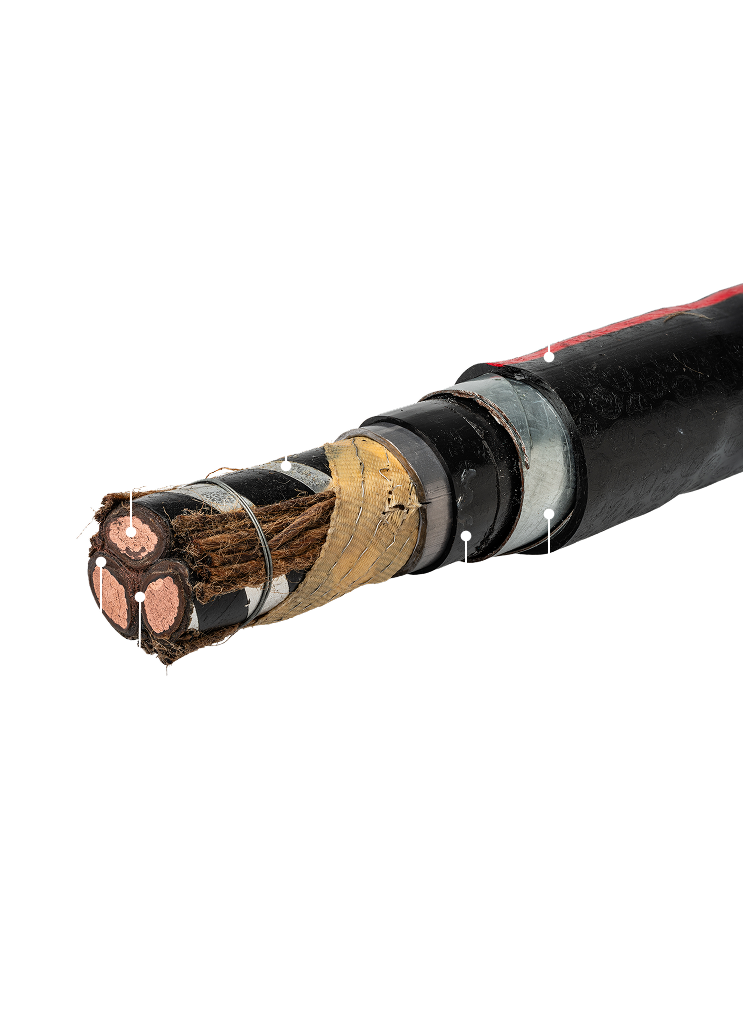

PILC is a durable, medium-voltage cable used for power transmission and distribution, especially in demanding environments and underground installations, due to its excellent electrical insulation and protective lead sheath. PILC cables are primarily used in applications requiring high reliability and durability For overhead and underground power line transmission and distribution by utility companies. To supply high-voltage power within manufacturing plants and large infrastructure projects. For high-voltage connections in projects like solar and wind farms. Powering trains and related infrastructural systems. Connecting various components and equipment in substations.
over long service lives.Primary Uses
Technical Data
There are various specifications used for this cable:
- Aluminium or Copper
- Different Voltages
- Armoured or Unarmoured (3 core Armouring – Steel Wire Armoured or Double Steel Tape Armoured) & (1 core Armouring – Aluminium Wire Armoured)
- (11kV and or the range 6.35/11kV 3 cores come in 3 tables):
- Table 17 – This cable is BELTED and works within the 6.35/11kV range and is EARTHED.
- Table 18 – This cable is BELTED and the voltage is 11/11kV and is UNEARTHED.
- Table 19 – This cable is SCREENED and works within the 6.35/11kV range and is EARTHED.
| Insulation | The core is insulated with oil-impregnated paper layers, which provide excellent electrical insulation. |
| Lead Sheath | A protective lead outer sheath offers protection against environmental stress, moisture, and physical damage. It also provides a reliable path for fault current. |
| Structure | PILC cables have an oil-filled, laminar structure, which contributes to their high reliability. |
| Diameter | The cables feature a compact sector design, resulting in a relatively small overall diameter that allows them to be installed in existing underground ducts. |
| Durability | The combination of paper insulation and the lead sheath makes PILC cables very robust and resistant to harsh conditions. |
| Long-Distance Capability | They are well-suited for transferring electricity over long distances without significant power loss. |
PILC cables are built in a concentric design, with each layer engineered for specific protection:
| Conductor | The inner core, typically copper or aluminium, carries the electrical current. |
| Paper Insulation | Layers of paper are wrapped around the conductor and saturated with a dielectric oil. |
| Lead Sheath | A seamless layer of lead is applied over the insulation. This is the critical barrier offering superior protection. |
| Outer Protective Layer | An optional external layer (e.g., plastic or metal) provides additional mechanical strength and protection. |
Key Features

SANS 97
PILC (SANS 97): Design complies with the South African National Standard 97.

Voltage Application
3 voltage options:
- Table 17 – This cable is BELTED and works within the 6.35/11kV range and is EARTHED.
- Table 18 – This cable is BELTED and the voltage is 11/11kV and is UNEARTHED.
- Table 19 – This cable is SCREENED and works within the 6.35/11kV range and is EARTHED.

Insulation Design
The core is insulated with oil-impregnated paper layers, which provide excellent electrical insulation.
Durability & Flexibility
Despite the robust construction, PILC cables maintain enough flexibility for easier installation in various configurations.
Superior Resistance
The Lead Sheath provides effective resistance against moisture (critical for insulation performance) and corrosive chemicals.
Reliability
Long history of low failure rates due to the robust construction, ensuring a long service life.